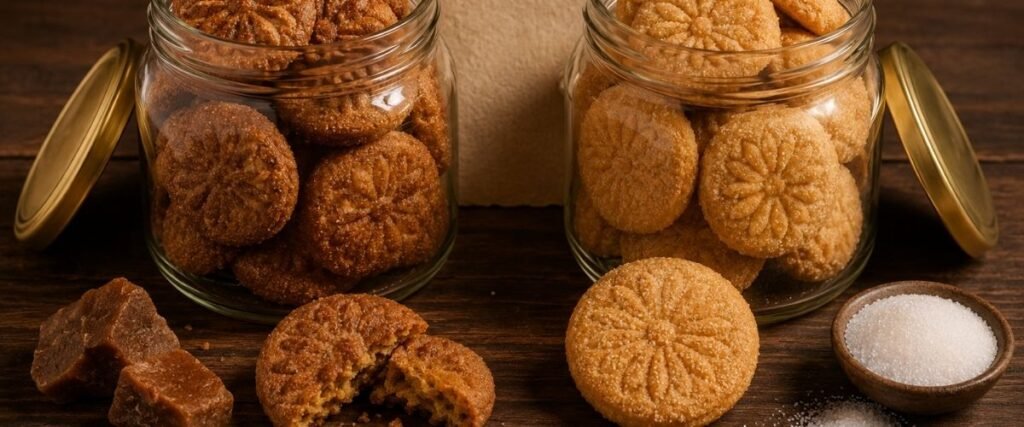
Jaggery Thekua vs Sugar Thekua: Which One Should You Choose?
Most people who order thekua for the first time ask the same thing: jaggery or sugar?
The honest answer in the jaggery thekua vs sugar thekua decision is that most people prefer jaggery. But the more useful answer is that they are genuinely different products: same dough, same ghee, same dried coconut, same slow frying process, and the difference between them is more specific than most comparison posts will tell you.
I’ve made both hundreds of times. Here’s what differs.
The Texture Difference — This Is What Matters Most
Most people who’ve ordered thekua don’t know this before their first bite.
Jaggery thekua is crunchy on the outside and slightly softer on the inside. The jaggery gives the interior a denser, more yielding quality. When you bite into it, there’s a distinct transition between the crisp outer layer and the softer centre. That contrast is part of what makes it satisfying — you get the crunch first, then the substance.
Sugar thekua has a fine crystallisation on the outer surface that forms as it cools after frying. This is what happens when sucrose recrystallises on contact with air; it creates a layer of very fine sugar crystals on the outside that makes the bite crunchier all the way through, with less of the softer centre. The texture is more uniform and more consistently crisp from edge to centre.
If you prefer a snack with textural contrast, a crunchy shell with a slightly softer inside, jaggery is your pick. If you prefer an even, consistent crunch from the first bite to the last, sugar is the one.
Neither is more authentic. They are two different eating experiences from the same base recipe.
The Taste Difference
Also known as gur ka thekua (jaggery thekua) and chini ka thekua (sugar thekua) in Hindi, the names describe what changes.
Jaggery thekua has a deeper, more complex sweetness. Jaggery is unrefined; it retains trace minerals like iron, potassium, and magnesium that refining removes from white sugar. These minerals contribute to the flavour, giving the sweetness an earthier, richer quality with a faint molasses-like undertone. It’s not sharp. It builds slowly and stays with you.
Sugar thekua is sweeter in a more familiar, more immediate way. White sugar is sucrose stripped of everything except sweetness, which means the flavour is cleaner and more straightforward. There’s no mineral undertone, no earthiness. If you’ve grown up eating standard Indian mithai made with refined sugar, the taste profile of sugar thekua will feel closer to what you already know.
Neither is more or less sweet in terms of intensity; both are made to the same ratio. The difference is entirely in character, not quantity.
The Colour Difference
This one is simpler: there’s barely one.
Jaggery thekua is slightly darker, a deep amber-brown that comes from jaggery’s natural colour. Sugar thekua is marginally lighter, a shade closer to pale gold. In a jar side by side, you’d notice it. In a jar on its own, most people wouldn’t think to notice.
The colour difference does not affect shelf life, texture, or nutritional profile in any meaningful way. It’s just pigment.
Why They Behave Differently — The Food Science
The texture difference between the two variants comes down to how jaggery and sugar behave differently during and after frying.
Refined white sugar is almost pure sucrose. When it’s in the dough, and the thekua is fried, some of the sugar migrates toward the surface. As the piece cools after frying, that surface sugar recrystallises, forming the fine, even layer of tiny sugar crystals that gives sugar thekua its through-and-through crunch.
Jaggery is unrefined; it contains sucrose but also non-sucrose compounds including minerals, traces of molasses, and other organic matter. These compounds interfere with crystallisation. Jaggery doesn’t recrystallise on the surface the same way refined sugar does, which is why jaggery thekua retains a slightly softer interior rather than a uniformly crisp bite.
Both behave differently in the dough too. Jaggery dissolved into syrup produces a dough that feels marginally denser. Sugar syrup at the same ratio produces a slightly looser dough. The frying compensates — same low flame, same 12-15 minutes, but the finished interior texture differs because of how each sweetener interacts with the wheat protein.
This is chemistry, not a quality difference. Both are made correctly.
Which Should You Choose?
Quick comparison:
Jaggery Thekua
Sugar Thekua
Texture
Crunchy outside, softer inside
Even crunch all the way through
Sweetness
Earthy, complex, mineral undertone
Clean, familiar, straightforward
Colour
Deep amber-brown
Slightly lighter gold
Best for
Traditional taste, textural contrast
Consistent crunch preference
Shelf life
90 days
90 days
Most popular
Yes — most buyers prefer this
Acquired taste
Choose jaggery if: You grew up eating thekua at home in Bihar or Mithila and want it to taste the way you remember. Jaggery thekua is the traditional standard. Most people who try both prefer it. The earthier sweetness and the crunchy-outside-softer-inside texture are what thekua has historically been.
Choose sugar if: You prefer a cleaner, more familiar sweetness without the mineral undertone of jaggery. Or if you specifically want an even, consistent crunch rather than textural contrast. Sugar thekua is an acquired preference; buyers who choose it tend to know they want it, rather than discover it by accident.
First order? Start with jaggery. It’s what most people are looking for when they order thekua. If you’ve had it before and preferred the lighter version, go sugar.
Gifting? Jaggery is the safer choice. It’s what most recipients expect thekua to taste like, and the earthier flavour tends to make more of an impression than the cleaner sugar version. Complete thekua gifting guide →
“When I taste a fresh batch, jaggery and sugar feel different in my hands before I even bite into them. The jaggery one has a slightly denser feel. The sugar one is more even. Both have to pass the same checks — aroma, crunch, colour — before anything goes out. But what you get when you eat them is genuinely not the same thing.”
— Geeta Singh, Co-Founder, The Thekua Company
Both Variants — What Stays the Same
Whichever you choose, everything else is identical:
Chakki atta — stone-ground whole wheat flour. Same source, same grind.
Desi ghee — in the dough and as the frying medium. Pure ghee throughout.
Dried grated coconut — same quantity, same texture contribution.
Shelf life — 90 days from the date of making, airtight jar, room temperature. Both variants.
No preservatives, no maida, no refined oil — both variants.
Made fresh after every order — both variants. No pre-made stock.
Order Both and Decide
The most direct way to answer the question for yourself is to order both and taste them side by side. The 250g pack is the right size for this — enough to form a real opinion without overcommitting to either.
250g Jaggery Thekua — ₹229 → Deep amber-brown. Crunchy outside, slightly softer inside. Earthy jaggery sweetness. Also available in 500g, 1kg, and 2kg.
250g Sugar Thekua — ₹229 → Slightly lighter. Even, consistent crunch from sugar crystallisation. Cleaner, more familiar sweetness. Also available in 500g, 1kg, and 2kg.
Made in Mithila. By homemakers who never stopped making it.
Frequently Asked Questions
The texture and taste differ. Jaggery thekua is crunchy on the outside with a slightly softer inside, jaggery doesn't recrystallise on the surface after frying the way refined sugar does. Sugar thekua has fine sugar crystallisation on the outer layer that creates an even, consistent crunch all the way through. In terms of taste, jaggery thekua has a deeper, earthier sweetness; sugar thekua has a cleaner, more familiar sweetness.
Jaggery is the traditional Mithila standard. The original recipe uses block jaggery dissolved into syrup. Sugar thekua is a widely available variant, but if you're looking for the version closest to what homemakers in Mithila have always made, jaggery is it.
Jaggery retains trace minerals, iron, potassium, magnesium, that refining removes from white sugar. It also has a slightly lower glycemic index. Jaggery thekua is nutritionally superior to sugar thekua on ingredient quality, but both are fried sweets and should be eaten in moderation.
Sugar thekua is crunchier all the way through, due to sugar crystallisation on the surface during cooling. Jaggery thekua is crunchy on the outside with a slightly softer inside. If consistent crunch matters more to you, choose sugar. If you prefer textural contrast, crunch outside and soft inside, choose jaggery.
Jaggery. It's what most people are looking for when they order thekua and what most buyers prefer. Sugar thekua is an acquired taste — buyers who choose it tend to know they specifically want it.
Yes. Both jaggery and sugar thekua last 90 days from the date of making, stored in an airtight container at room temperature. No preservatives in either variant.
Yes. Ordering both in 250g packs is the best way to taste the difference side by side and decide which you prefer for repeat orders.
About the author
Geeta Singh
Co-Founder, The Thekua Company & Mithila House
Geeta never learned thekua from a written recipe. She learned by watching, standing next to women who had been doing it for decades, getting it wrong until her hands got it right. The dough consistency, the ghee temperature, the moment it\'s ready to come out, none of it has a timer. Her hands know. Every batch at The Thekua Company is made to that standard.