If you’ve grown up in Bihar or Mithila, you’ve used these names interchangeably. Most people have. In everyday conversation, khajuria and thekua refer to the same kind of fried sweet — the thing in the steel dabba, the Chhath prasad, the 4pm chai companion, the food someone always brought back from home.
But in a kitchen, they’re not the same thing. And in a market where brands are selling one as the other, the difference matters more than it ever did in the kitchen.
Here’s what separates them.
The Names Come From Different Places
The word thekua comes from thokna, to hammer or to press. It describes the making process: dough pressed firmly onto a carved wooden sancha mould to transfer its pattern. The name is about the action.
The word khajur or khajuria, also spelt khajuriya in some regions, comes from khajur, the date fruit. The sweet is named after it resembles a date: oblong, small, brown, slightly elongated. The name is about the shape.
Two different words. Two different origins. Two foods that became neighbours in the same cultural space and gradually got called by each other’s names in casual use, the way most traditional foods do. The recipes, however, did not drift the same way.
The Ingredient Distinction — This Is What Matters
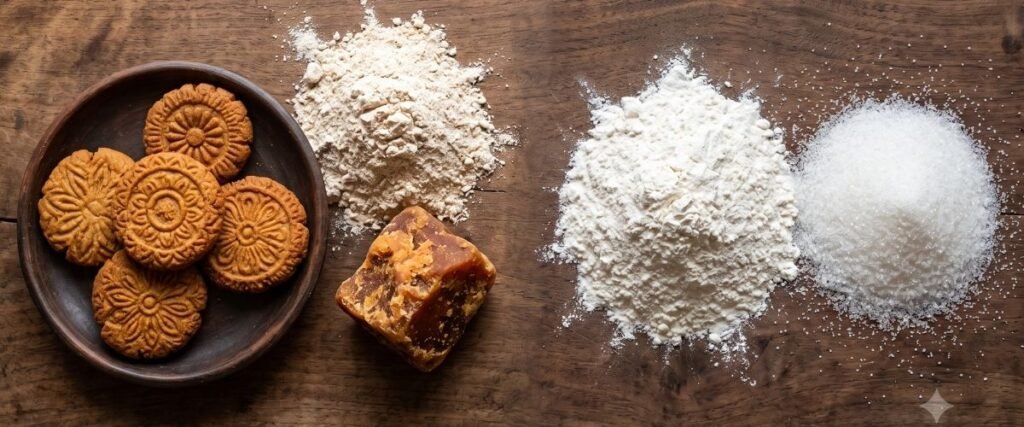
Authentic thekua is made from chakki atta, stone-ground whole wheat flour, and nothing else in the flour category. The entire dough base is whole wheat. No semolina added for texture. The sweetener in the traditional version is block jaggery, though sugar thekua also exists and is genuine. The frying medium is desi ghee.
Khajuria, the version sold widely across Bihar and online, is often made with maida (refined flour), or a combination of maida and atta. Sometimes semolina (sooji or rava) is added to create a lighter, crispier texture that atta alone doesn’t produce. The sweetener is usually sugar rather than jaggery. Some versions use refined oil rather than ghee.
This is not a minor variation. Maida and chakki atta are nutritionally and texturally different ingredients. Maida is refined wheat flour with the bran and germ removed; it produces a lighter, crispier result but has a fraction of the fibre, vitamins, and minerals of whole wheat. Jaggery retains trace minerals that refined sugar loses. Ghee has natural preservation properties that refined oil does not.
When a brand uses maida and calls the product thekua, they are selling a different product. Not a worse one necessarily; khajuria made well is a fine snack. But it is not thekua.
Why the Confusion Exists — And Why It’s Getting Worse
The confusion between the names is old and largely harmless at the cultural level. In Bihari kitchens, a grandmother who makes her khajuria with maida and calls it thekua is not deceiving anyone. The name in that context carries the feeling of the food, not the specific recipe.
The problem arrives when that confusion is exploited commercially.
Online, several brands sell maida-based products labelled as “authentic thekua,” “traditional thekua,” or “Mithila thekua”, using the cultural authority of the name without the ingredient integrity behind it. A buyer searching for the real thing, the whole wheat, jaggery, ghee version, has no easy way to tell the difference from a product listing without reading the full ingredient list carefully.
We’ve seen the orders. Customers who received maida-based khajuria from other sellers and came to us specifically because they wanted thekua that matched what they remembered. The texture is different, the taste is different, and the shelf life is shorter because maida doesn’t behave the same way atta does after frying. Once you know what you’re looking for, you can taste the difference immediately.
“When we started The Thekua Company, we tasted what other brands were selling as thekua. Some of it was good — as a snack. But it wasn’t thekua. You can taste the maida. You can feel the difference in how it holds. We decided we would only make the real thing, and we would say exactly what’s in it.”
— Neetu Yadav, Co-Founder, The Thekua Company
How to Tell Which You’re Buying
Before ordering any thekua online, read the ingredient list. Skip the product name and the packaging headline — the actual ingredient list is the only thing that matters.
Signs you’re buying authentic thekua: The first ingredient is whole wheat flour (atta), chakki atta, or gehun ka atta. The sweetener is jaggery (gur) or sugar, not a combination of both plus additional sweeteners. The frying medium is desi ghee. The ingredient list is short, four or five items, all of which you recognise.
Signs you’re buying khajuria marketed as thekua: Maida (refined flour) appears in the ingredient list, either alone or alongside atta. Semolina (sooji or rava) appears; this is a khajuria texture technique, not a thekua one. Refined oil or vanaspati appears as the frying medium. The ingredient list is longer than it should be for a product claiming to be traditionally made.
The shelf life is also a signal. Genuine thekua made from chakki atta, jaggery or sugar, and desi ghee lasts 90 days at room temperature without preservatives. This is because of the specific combination of low moisture from frying, ghee as a natural oxygen barrier, and the preservative properties of jaggery or sugar concentration. Maida-based khajuria typically has a shorter shelf life; the finer flour and different fat profile produce a different preservation outcome. If a product claims to be traditional thekua but lists a shelf life significantly shorter than 90 days, the recipe is likely not what the name implies.
Every batch at The Thekua Company uses chakki atta — stone-ground whole wheat flour. The sweetener is block jaggery (dissolved into syrup before use) or white sugar, depending on the variant ordered. The frying medium is desi ghee throughout. Dried grated coconut goes into the dough — the specific Mithila detail that distinguishes our recipe from generic Bihar-region versions.
The ingredient list on our packaging has four items. That’s the complete list.
Made in Mithila. With chakki atta, jaggery, and ghee. Nothing else.
Frequently Asked Questions
The names are used interchangeably in everyday speech across Bihar and Mithila. But the products can differ significantly. Authentic thekua is made from chakki atta (whole wheat flour), jaggery or sugar, and desi ghee. Khajuria is often made from maida (refined flour) or a maida-atta combination, usually with sugar and sometimes refined oil. Some brands sell maida-based khajuria under the thekua name.
The primary difference is in the flour. Thekua uses chakki atta (stone-ground whole wheat flour). Khajuria typically uses maida (refined flour) or a maida-atta blend. This affects texture (thekua is denser, khajuria is lighter and crispier), nutritional profile (atta has significantly more fibre and minerals than maida), and shelf life (genuine atta-and-ghee thekua lasts 90 days; maida-based khajuria typically shorter). The cultural distinction also matters — thekua is the traditional Chhath Puja prasad; khajuria is more of an everyday snack without the same ritual significance.
The names have drifted together over generations in casual use. In traditional kitchens, the distinction was understood but not always stated, most families made one or the other and called it what their household called it. Commercially, the drift became a problem when brands began using the culturally significant "thekua" name for maida-based products to benefit from the name's association with tradition and Chhath Puja.
Read the ingredient list. If the first ingredient is chakki atta or whole wheat flour, and the sweetener is jaggery or sugar, and the frying medium is desi ghee, that's thekua. If maida appears, if semolina (sooji) appears, or if refined oil appears, that's khajuria, regardless of what the label says.
Authentic thekua made from chakki atta, jaggery or sugar, and desi ghee lasts 90 days at room temperature without preservatives. Maida-based khajuria typically has a shorter shelf life because the ingredient combination produces different moisture and oxidation dynamics after frying.
The Thekua Company makes authentic thekua, chakki atta, block jaggery or sugar, desi ghee, and dried grated coconut. No maida, no semolina, no refined oil. The ingredient list has four items. Both jaggery and sugar variants are available.
Khajur means "date" (the fruit) in Hindi and Urdu. The sweet is named after its resemblance to a date in shape — small, oblong, brown. Khajuria is the diminutive form. Thekua, by contrast, comes from thokna (to press or hammer), describing the making process.
About the author
Neetu Yadav
Co-Founder, The Thekua Company & Mithila House
Neetu grew up in Mithila, where thekua was never a festival food; it was just food. The snack in the steel dabba is made every week, without a recipe card. She co-founded The Thekua Company to give that everyday food the everyday market it always deserved. Every batch that leaves the kitchen meets the standard she grew up with.