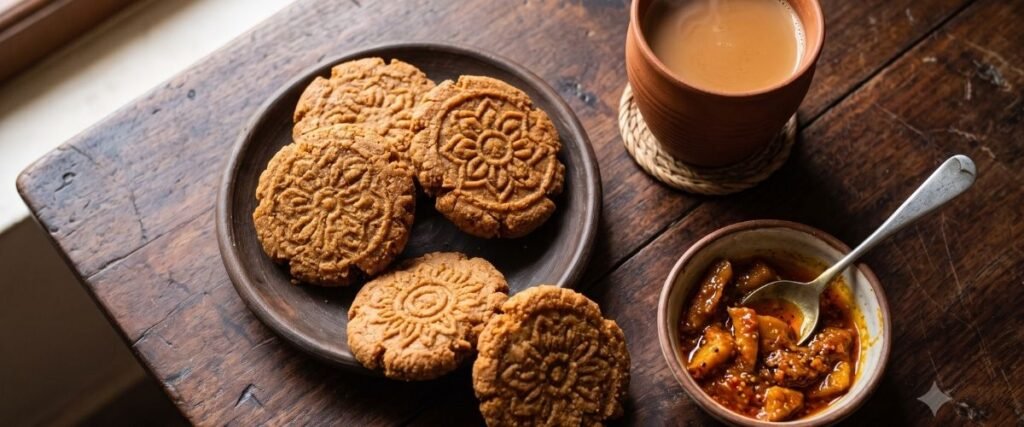
Everyone knows what to eat with thekua at a basic level: chai. That part isn’t news to anyone who grew up in Bihar or Mithila.
What most people outside the region don’t know is that chai isn’t the only pairing that’s traditional. In Mithila’s kitchens, thekua has long been eaten alongside spicy pickle, something sharp and sour cutting against something dense and sweet. It sounds like an unlikely combination until you understand why it works, and then it stops sounding unlikely at all.
Thekua pairs traditionally with two things: masala chai, whose tannins cut through the richness of desi ghee, and spicy Mithila pickle, whose sourness contrasts against thekua’s sweetness.
This is a short, practical guide to what actually goes with thekua, the everyday pairing, the traditional one most people have never heard of, and the food chemistry behind why both work.
Chai — The Everyday Pairing
This is the pairing thekua was built for. One piece, a cup of hot milky chai, and there’s a reason this combination has survived unchanged for generations.
Why it works — tradition backed by chemistry: Chai, brewed black tea with milk and spices, contains tannins, the same astringent compounds found in red wine. Tannins bind to the proteins and fats in your mouth and clear them away, refreshing your palate after every sip. This is why tannic tea is traditionally served with rich, fried, or fatty foods across cultures, from British breakfast tea with a full English fry-up to Chinese black tea with dim sum. Thekua, fried in ghee with a dense, buttery mouthfeel, is exactly the kind of food that benefits from this effect.
There’s a second layer to why this works: fat softens tannin’s astringency, creating a smoother, creamier mouthfeel than either the tea or the thekua would produce alone. The ghee in thekua and the tannins in chai work on each other, each changing how the other tastes.
How to do it right: Strong, well-brewed masala chai, cardamom and ginger are the classic additions. The chai should be robust enough to stand up to the richness of the ghee. A weak, milky tea gets lost against thekua’s density.
Spicy Pickle — The Pairing Mithila Actually Eats
This is the one that surprises people who’ve only ever had thekua at Chhath Puja, or bought it without knowing its regional roots.
In Mithila’s kitchens, thekua is traditionally eaten alongside spicy, sour pickle — specifically Oal ka Achaar or Suran ka Achaar (yam pickle) and Mithila’s mango pickle, made with raw green mango, mustard oil, and a sharp blend of spices. This isn’t an obscure regional footnote. JhaJi Store, a Mithilanchal pickle maker working directly with local farmers in Darbhanga, documents this pairing explicitly — noting that thekua “tastes really well with spicy and lustrous pickles.”
Why this works, and it’s not random: This is contrast pairing — one of the two foundational principles of flavour pairing, the other being pairing by similarity. Contrast pairing works by placing opposing flavour profiles next to each other so each one sharpens the other. Thekua is dense, sweet, and rich from ghee. Mithila’s pickles are sharp, sour, and pungent from mustard oil and chilli. Eaten together, the pickle cuts through the richness of the ghee the same way chai’s tannins do — but through acidity and heat instead of astringency. The sweetness of the jaggery becomes more pronounced against the pickle’s sourness. Neither flavour gets lost; both get sharper.
This is the same underlying principle that makes tomato and basil work, or lemon and fatty fish. Regional food traditions arrive at these pairings generations before anyone writes the flavour science down — Mithila’s kitchens knew this pairing worked long before “contrast pairing” was a term in a flavour chemistry textbook.
How to do it right: A small amount of pickle alongside thekua, not mixed together. Take a bite of thekua, then a small taste of pickle, and notice how the sweetness of the jaggery becomes more distinct immediately after. This is traditionally eaten as an evening snack pairing — not a meal, a specific in-between-meals combination that Mithila’s kitchens have quietly maintained for generations.
“Chai is what everyone knows thekua with. But growing up, pickle was there too, not with every batch, but often enough that it wasn’t unusual. You’d have a piece of thekua, then a small bite of achaar, and the two would talk to each other. Now that I know why it works, the sweet and the sour doing something to each other, it makes sense. But as a child, nobody explained it. It just tasted right.”
— Geeta Singh, Co-Founder, The Thekua Company
What Else Works
Beyond the two traditional pairings, a few others are worth knowing, some from broader Indian snacking culture, some just practical.
Plain milk tea (no chai spices). If masala chai feels too heavy, a simpler milk tea achieves a similar tannin effect with less competing flavour. Good for someone trying thekua for the first time who wants to taste it clearly.
Black coffee. Coffee has its own bitter compounds that work similarly to tea tannins, cutting through richness rather than adding to it. Less traditional, but works on the same principle.
Nothing at all. Thekua is dense and satisfying enough to eat on its own, which is exactly why it worked as a travel food and an everyday snack long before pairing was ever a consideration. Don’t feel obligated to pair it with anything; some of the best thekua eating happens standing in a kitchen, straight from the jar. What’s actually in each piece →
What doesn’t work as well: Very sweet accompaniments. A second sugary item alongside thekua doesn’t create contrast or complement; it just stacks sweetness on sweetness, and the jaggery’s complexity gets flattened rather than sharpened.
Why This Matters Beyond Snacking
Understanding what thekua pairs with is understanding what kind of food it is, a snack food, meant to sit alongside other flavours throughout the day, rather than a dessert eaten in isolation at the end of a meal the way many Western sweets are. It shows up with chai in the afternoon, alongside pickle in the evening, or completely alone on a long journey.
That’s the everyday-food identity that got buried when thekua retreated to festival-only status. Nobody pairs prasad with pickle. But nobody thought of thekua as prasad either, until packaged snacks pushed it out of daily rotation and Chhath became the only occasion guaranteed to keep it on the table. More on how thekua became a festival food →
Pairing it properly, with chai, with pickle, or just on its own whenever you want it, is part of putting it back where it belongs.
Try It Both Ways
The best way to understand these pairings is to try them yourself. Order a jar, make chai the way you normally would, and if you have any Bihari or Mithila-style pickle at home- mango, yam, anything with mustard oil and real heat- try a small bite alongside.
Made in Mithila. By homemakers who never stopped making it.
Frequently Asked Questions
The most common pairing is chai, strong, milky masala chai whose tannins cut through the richness of the ghee. In Mithila's kitchens, thekua is also traditionally eaten with spicy pickle, especially mango pickle or Oal/Suran ka Achaar (yam pickle), where the pickle's sourness and heat contrast against thekua's sweetness and density.
Chai contains tannins, astringent compounds that bind to proteins and fats in the mouth and clear them away, refreshing the palate. Thekua is dense and rich from desi ghee, making it exactly the kind of food that benefits from tannin's palate-cleansing effect. This is the same principle behind pairing tannic tea or wine with any rich, fried food.
It's a real, documented tradition specific to Mithila's food culture. Thekua is traditionally paired with spicy pickles like mango pickle and Oal ka Achaar, the pairing works through flavour contrast, where the pickle's sourness and heat sharpen the sweetness of the jaggery rather than competing with it.
Yes. Thekua was historically a standalone snack and travel food precisely because it didn't require anything alongside it, it's dense and satisfying enough to eat by itself. Pairing with chai or pickle enhances the experience but isn't necessary.
Mango pickle (particularly Mithila-style mango pickle made with raw green mango and mustard oil) and Oal or Suran ka Achaar (yam pickle) are the traditional pairings from Mithila's own kitchens. Both are sharp, sour, and spiced, a contrast to thekua's sweet, dense richness.
Black coffee works on a similar principle to chai, its bitter compounds cut through the richness of the ghee, though it's less traditional than chai. Either works if you prefer coffee to tea.
About the author
Geeta Singh
Co-Founder, The Thekua Company & Mithila House
Geeta never learned thekua from a written recipe. She learned by watching, standing next to women who had been doing it for decades, getting it wrong until her hands got it right. The dough consistency, the ghee temperature, the moment it\'s ready to come out, none of it has a timer. Her hands know. Every batch at The Thekua Company is made to that standard.