
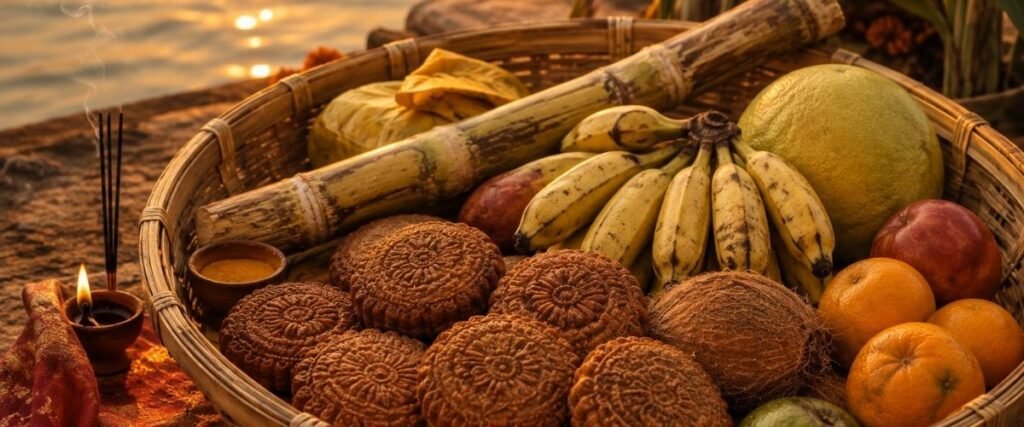
Chhath Puja is one of the most demanding acts of devotion observed anywhere, a four-day festival built around a 36-hour fast without water, standing in a river at sunset and again at sunrise, and an offering made with a level of care that most festivals don’t ask for. Thekua sits at the centre of that offering. Understanding why starts with what the festival asks of the people observing it.
What Chhath Puja Is
Chhath Puja is a four-day Hindu festival of thanksgiving to Surya Dev, the Sun God, and to Chhathi Maiya, who is deeply revered as the one families pray to for the wellbeing and protection of their children and their household. It is observed primarily across Bihar, Jharkhand, and eastern Uttar Pradesh, and by the Maithili and Bihari diaspora wherever they now live — from riverbanks in Patna to parks in London.
Chhath Puja 2026 falls from Friday, 13 November to Monday, 16 November.
The four days follow a fixed sequence:
Nahay Khay (13 November) — the first day. Devotees bathe, clean their homes, and eat a single simple meal.
Kharna (14 November) — a day of fasting that ends in the evening with a meal, after which the main 36-hour waterless fast begins.
Sandhya Arghya (15 November) — the principal day. Devotees, standing in a river, pond, or other water, offer prayers and arghya (a ritual offering) to the setting sun.
Usha Arghya (16 November) — the final morning. The same offering is made to the rising sun, and the fast is broken.
There are no idols in Chhath Puja and no priests required to perform it. It is one of the few major Hindu observances centred entirely on direct devotion, water, sunlight, and the person offering it.
Why Thekua Is the Prasad
The food prepared for Chhath is held to a standard of purity that shapes everything about how it’s made. It is cooked without onion or garlic, without any non-vegetarian ingredient, following satvik principles that apply across the entire festival — from the single meal on Nahay Khay to the prasad offered on the final two days.
Thekua fits this standard because of what it already is. Wheat flour, jaggery, and ghee — nothing added, nothing that compromises the purity the festival asks for. It has met that requirement for generations of families who make it this way regardless of the occasion.
There’s a practical dimension too. Chhath prasad is prepared in advance, often in large quantities, to be offered at the ghat and shared afterwards with family, neighbours, and anyone present. Thekua can be made ahead, keeps without spoiling, and travels to the riverbank without any special handling. Few foods meet the purity requirement and the practical demands of a four-day outdoor festival as naturally as thekua does.
Made Together
In Neetu and Geeta’s families, making thekua for Chhath is a household activity, not something one person does alone in the kitchen. Everyone sits together, pressing the dough into the sancha, one batch after another, and once it’s made, the family goes to the ghat together for the puja.
An Offering, and Also an Everyday Food
Thekua’s place in Chhath Puja is not in question — it is the primary prasad of one of the most significant festivals observed in Bihar, Jharkhand, and Mithila, and that significance doesn’t need any qualification.
What’s also true, and doesn’t take anything away from that, is that thekua has historically been more than a festival food. In Mithila’s kitchens, the same wheat-jaggery-ghee thekua made for Chhath prasad was also the thing kept in the steel dabba year-round — eaten with chai, packed for journeys, offered to guests on an ordinary Tuesday. More on thekua’s place in everyday life →
Both of these are true about the same food at the same time. The sacred offering and the everyday snack aren’t in competition with each other, a food doesn’t become less meaningful at Chhath because it’s also good on a Tuesday, and it doesn’t become less of an everyday food because it’s also what’s offered to Chhathi Maiya. That’s what thekua has always been.
If You’re Preparing for Chhath
The Thekua Company makes thekua the same way it’s always been made — chakki atta, jaggery, desi ghee, and dried coconut, fried slowly and made fresh after every order. If your family is preparing for Chhath this year and wants the same thekua at home without making it from scratch, or wants extra for sharing with family who live elsewhere, it ships pan-India with time to spare before 13 November.
Order handmade thekua — ships fresh across India →
The full recipe, if you’re making it yourself this year →
Made in Mithila. By homemakers who never stopped making it.
Frequently Asked Questions
-
Chhath Puja 2026 is observed from Friday, 13 November to Monday, 16 November. The main Sandhya Arghya (evening offering) falls on 15 November, and Usha Arghya (morning offering, when the fast breaks) falls on 16 November.
-
Thekua is the primary prasad of Chhath Puja. It's made from wheat flour, jaggery, and ghee, ingredients that already meet the satvik (pure) standard the festival requires, without onion, garlic, or non-vegetarian ingredients. It can also be made in advance and keeps well, which matters for a four-day outdoor festival.
-
Nahay Khay, Kharna, Sandhya Arghya, and Usha Arghya, in that order. Chhath always falls on Kartik Shukla Shashthi in the Hindu calendar, a few days after Diwali.
-
No. Thekua has historically been an everyday food in Mithila as well as the primary Chhath prasad — both are true of the same food. It was traditionally kept in the kitchen year-round, eaten with chai and packed for journeys, in addition to its role in Chhath.
-
Primarily in Bihar, Jharkhand, and eastern Uttar Pradesh, and among the Maithili and Bihari diaspora across India and internationally.
-
Yes. The Thekua Company ships handmade thekua pan-India, made fresh from chakki atta, jaggery, desi ghee, and dried coconut. Order with enough time before 13 November for delivery to your location.

About the author
Neetu Yadav
Co-Founder, The Thekua Company & Mithila House