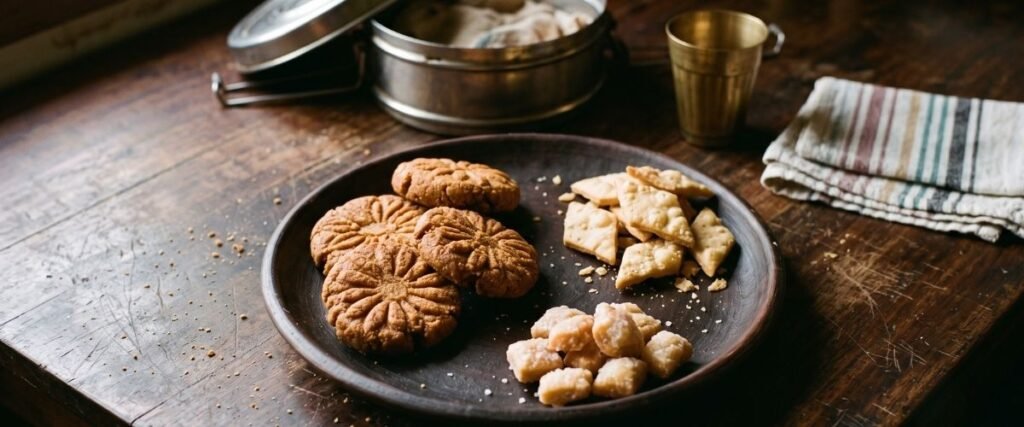
When a guest arrived at our house in Mithila, my mother didn’t reach for a biscuit packet. She opened the steel dabba.
Inside was thekua, made from wheat, jaggery, and ghee, firm and golden, smelling like a kitchen that had been cooking something real. It was put in front of guests as a matter of course. Not because my mother had prepared it specially. Because the dabba was always stocked. Because that was what you offered people.
That memory is not unusual. Everyone I know from Bihar and Mithila has a version of it, the steel dabba, the handmade snack inside, the casual hospitality that didn’t require a trip to a shop.
Ask those same people what they serve guests today.
What Indian Kitchens Kept
Before traditional Indian snacks lost their everyday place, the 4pm snacking occasion looked different in most households across Bihar, Jharkhand, eastern UP, and much of rural India.
Thekua — wheat, jaggery, ghee, pressed and fried. Lasted three months without refrigeration. Made in batches, kept on the shelf, eaten whenever. Served to guests. Sent with children to school. Packed for long journeys specifically because it wouldn’t spoil. And given to new mothers recovering after childbirth — the combination of whole wheat, jaggery’s iron content, and ghee’s fats made it one of the foods that Mithila kitchens kept close during the postpartum period for faster recovery. Nobody called it a superfood. It was just what was made. What worked.
Nimki — small fried savoury crackers made from atta or maida, seasoned with carom seeds (ajwain) or black pepper. Crunchy, portable, long-lasting. The savoury counterpart to thekua in the same steel dabba.
Shakarpara — fried sweet diamond-shaped pieces made from maida, sugar, and ghee. Crisp, not too sweet, better in a jar than any biscuit. A staple of festive and everyday kitchens alike.
Mathri — flaky, savoury fried flatbreads from Rajasthan and UP kitchens, eaten with pickle, with chai, with nothing at all.
None of these foods was complicated. All of them were made from three or four ingredients. All of them lasted weeks without preservatives. Every one of them was better for you than what replaced them.
The question is not why they were made. The question is why they stopped being made every week.
When the Biscuits Arrived
India’s economic liberalisation in 1991 changed many things. Among them: the FMCG sector got access to capital, distribution infrastructure, and national marketing budgets that no regional traditional food had ever had.
Parle-G had been around since 1929. But it was the 1990s and early 2000s that changed everything — the aggressive push into tier-2 cities, into rural mandis, into the corner shops of every small town in Bihar and Jharkhand. The biscuit industry, once formed of small local manufacturers emerging from regional exchange, became one of the fastest-growing sectors in Indian food after liberalisation.
The reach was the point. You didn’t need a kitchen to produce a biscuit for a customer in Darbhanga. You needed a supply chain. And the large FMCG companies built that supply chain while traditional food had none.
A packet of Parle-G cost two rupees. It was available at every shop. It didn’t require anyone to spend two hours making it. It had a consistent texture every time. For a household with a working mother, a shrinking joint family, and a corner shop fifty metres away, the choice wasn’t really a choice. It was convenience versus effort, and convenience won by default.
What nobody calculated was what was lost in the transaction.
What the Displacement Cost
The displacement of traditional snacks wasn’t neutral. It wasn’t simply one product replacing another of equal value.
The nutrition gap is real. A glucose biscuit is primarily refined flour, refined sugar, and palm oil — ingredients stripped of fibre, minerals, and anything the body can use beyond calories. Thekua is whole wheat, jaggery (with its iron and potassium), and ghee. Nimki and shakarpara use more refined ingredients but in quantities that people controlled, rather than industrial formulations optimised for shelf life and cost minimisation.
The knowledge gap is harder to measure but more permanent. When a food stops being made weekly, the people who knew how to make it age. Their children don’t learn. Within a generation, the recipe that lived in hands for a century exists only in occasional memory. The jaggery syrup method for thekua. The exact dough consistency for nimki. The temperature read for shakarpara. These are not things that survive in a recipe card — they survive in practice. Stop the practice, and you lose the knowledge.
The occasion gap changed how food was understood. When thekua stopped being served to guests every week, it retreated to the one occasion that guaranteed it would still be made: Chhath Puja. When shakarpara stopped being an everyday kitchen item, it became Diwali food. Nimki followed the same path, chai companion to occasional relative’s kitchen speciality. Festival association is not inherently bad, but for a food, becoming festival-only is usually the last stage before disappearing entirely. You make something once a year, and eventually you stop making it at all.
“In our house, thekua wasn’t served because we were being traditional. It was served because it was there, because it was good, and because it was what you put in front of people who came to your door. The biscuit didn’t replace it because it was better. It replaced it because it was available everywhere and required nothing from us. That’s a different thing.”
— Neetu Yadav, Co-Founder, The Thekua Company
Three Paths Traditional Snacks Took
Not every traditional snack followed the same trajectory. Three paths emerge from what happened across the category.
Path 1 — Festival only. Thekua, shakarpara, anarsa, gujiya. Foods that held on because they were tied to specific rituals that couldn’t be replaced by a biscuit. Still made, still loved, but only at the appointed time. Profitable for nobody. Known only to people who grew up with them.
Path 2 — Scaled and industrialised. Mathri, namkeen, bhujia. These survived commercially because they adapted to factory production. Bikaji, Haldiram’s, and similar brands packaged and distributed them at scale. They became FMCG products themselves. The cost: standardisation. A Haldiram’s mathri is fine. It is not the same as what came out of a specific kitchen.
Path 3 — Quietly disappeared. Foods that had neither a festival association to protect them nor a format that suited industrial production. These are the ones nobody can name anymore, the specific regional variations, the neighbourhood recipes, the things that were made in a particular district of Bihar by a particular community and nowhere else. These are gone. The knowledge is gone. The ingredients are still available. The hands that knew what to do with them are not.
What’s Happening Now
Something has shifted in the last five years. It’s not a revolution, but it’s real.
A small number of D2C brands have started building the commercial infrastructure that traditional foods never had. Real businesses with websites, packaging, delivery, and repeat customers, not preservation projects or heritage museums. Direct-to-consumer brands are using social media to build loyalty around clean labelling and regional authenticity, something packaged snacks never offered.
The demand was always there. People from Bihar who moved to Bangalore and couldn’t find real thekua. People from Rajasthan in Delhi who wanted proper mathri. The diaspora, the curious, the health-conscious buyers looking for an alternative to palm oil and maida. Traditional snacks still represent nearly half of India’s savoury snack market by value; the demand never disappeared. The distribution did.
The Thekua Company is one answer to that gap, specifically for thekua, nimki coming, shakarpara coming, built not as a nostalgia project but as a real business that ships handmade food to people who want it. Read about the homemakers who make it →
The larger question, whether enough of these businesses emerge fast enough, before the last generation of homemakers who carry the knowledge ages out, is one that nobody has answered yet.
What You Can Do
The most direct thing is also the simplest: buy the real version when it’s available, and buy it regularly. Not as a festival purchase. As a weekly snack.
A food that has a reliable year-round market survives. A food that sells once a year doesn’t. The biscuit didn’t win because it was better. It won because it had a market. Building that market back for thekua, for nimki, for whatever the next traditional food that deserves a shelf is, that’s how this reverses.
Made in Mithila. By homemakers who never stopped making it.
Frequently Asked Questions
Across Bihar, Jharkhand, eastern UP, and Mithila specifically: thekua (wheat, jaggery, ghee), nimki (savoury fried crackers), shakarpara (sweet fried pieces), and mathri (flaky savoury fried flatbreads) were all everyday kitchen staples before packaged biscuits arrived at scale. Most have retreated to festival-only or occasional production.
Distribution and convenience, not quality. FMCG companies built supply chains that reached tier-2 and rural markets after economic liberalisation in the 1990s. Traditional foods had no equivalent commercial infrastructure. A packet of Parle-G was available at every corner shop. Homemade thekua required two hours and a kitchen. The scale, not the product, determined the outcome.
Most traditional Indian snacks made from whole wheat, jaggery, and ghee are nutritionally superior to glucose biscuits made from refined flour, refined sugar, and palm oil. Thekua specifically uses chakki atta (whole wheat), jaggery (which retains iron and potassium), and desi ghee. A biscuit uses maida, refined sugar, and refined palm oil. The nutritional gap is significant.
Yes. The Thekua Company makes and ships handmade thekua pan-India — chakki atta, jaggery or sugar, desi ghee, dried coconut. Made fresh after every order. 90-day shelf life without preservatives.
Thekua is a traditional fried sweet from Mithila made from whole wheat flour, jaggery, and ghee. In Mithila's kitchens, it was kept near new mothers recovering after childbirth — the combination of whole wheat's fibre, jaggery's iron content, and ghee's fats made it a sustaining, practical food for the postpartum period. Its 90-day shelf life meant it could be made in advance and kept without refrigeration.
The Thekua Company is building the commercial infrastructure that traditional Mithila food never had — starting with thekua, extending to nimki, shakarpara, and eventually every significant recipe from the region under the Mithila House platform. The goal is not to preserve these foods as cultural artefacts but to give them a reliable year-round market.
About the author
Neetu Yadav
Co-Founder, The Thekua Company & Mithila House
Neetu grew up in Mithila, where thekua was never a festival food; it was just food. The snack in the steel dabba is made every week, without a recipe card. She co-founded The Thekua Company to give that everyday food the everyday market it always deserved. Every batch that leaves the kitchen meets the standard she grew up with.